Tuesday, February 28, 2012
Monkeys and Fairness
Below is an excellent video on pro-social behavior and fairness among monkeys. The good stuff is at 12:00min and 14:40. Monkeys demonstrate interdependent utility functions.


Monday, February 27, 2012
Dog Names and Breeds
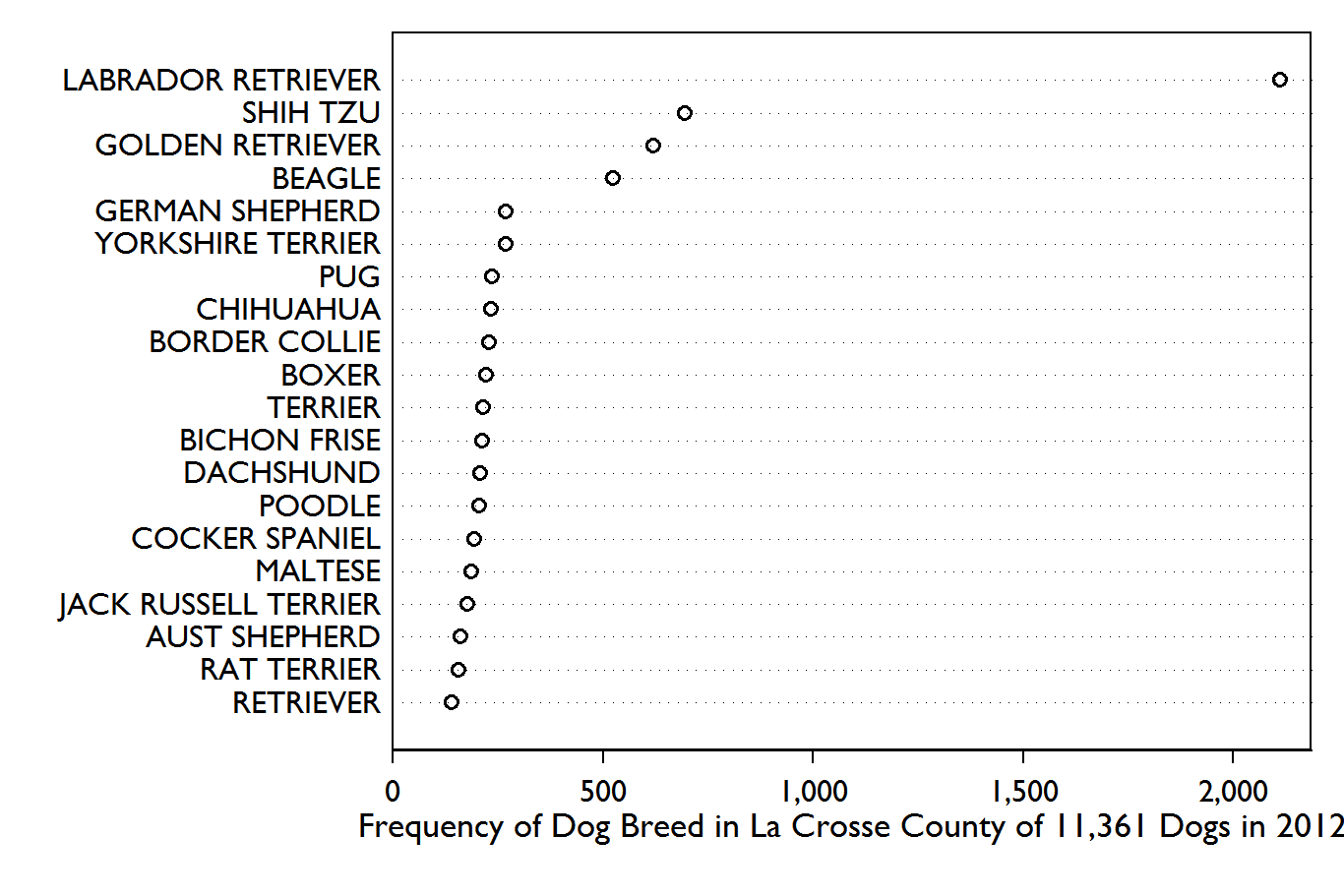
I love data. As an Economist and Professor you sometimes find yourself with interesting datasets that need to be shared. I have a group of students doing a project for a dog daycare in town. In order to survey dog owners we got the list of dog licenses from the county. It has the name, address of the owner, and the name, sex and breed of the dog. Below we have the top 20 names for dogs in La Crosse County for 2012. Remember these are licensed dogs.

Below I have the top 20 breeds from La Crosse.


Below I have the top 20 breeds from La Crosse.
Tuesday, January 24, 2012
One Percent
Do you want to join the one percent? Getting a degree from the college of business increases your chances. The NYT breaks down the top one percent by undergraduate degree.


Monday, January 23, 2012
What Not To Do
A great example of how not to design and deliver a presentation. In this commercial Microsoft demonstrates why they suck, or at the very least why their Ad Agency sucks.
Monday, January 16, 2012
Binge Drinking
Below we have a chart that visualizes the rate of binge drinking by state, which I'm grabbing from this blog. The Midwest to some degree, and the colder northern regions to a larger degree, appear to have the highest rates. What are some theories that can explain this relationship?


Monday, January 02, 2012
Krugman
Here is yet another great reason I have trouble respecting Krugman these days. In fact at one point thought I would write a blog post listing all of his intellectual flips, but the list grew too long. As Alex points out at the end:
Now to be fair, Krugman covered himself in 2003 in a credible way he said “unless we slide into Japanese-style deflation, there are much higher interest rates in our future.” Thus, I do not fault Krugman’s forecasting ability. What I do fault is that despite a 180 degree about-face, one thing remains constant in all of Krugman’s writings, anyone who disagrees with him is portrayed as a mendacious idiot. In truth, Heritage today and Krugman 2003 both have legitimate concerns about the long-term debt situation of the United States and it would have been to the credit of Krugman 2012 had he acknowledged that point more fairly.Yeah, Krugman covers his bases so as to have intellectual wiggle room. I get the reasons he does what he does - as a rhetorical style. But as an academic, I don't respect the lack of intellectual honesty and lack of openness Krugman now has. They were qualities I had so admired in the Krugman of old, despite our policy differences.
Sunday, December 25, 2011
Childhood Obesity Falls?
According to this piece in the Atlantic childhood obesity has fallen in NYC. They attribute the results to several interventions designed to solve the problem. But I wonder to what degree this is one of the happy side effects of a prolonged recession? Parents have less money to satiate the sugary demands of their children.
As I explained to Bloomberg News, if this trend continues, it will represent the first truly positive development in years.
It also suggests that the health department's unusually aggressive efforts to address obesity may be paying off. If so, they should inspire other communities to do the same kinds of things. If nothing else, they raise awareness of the problem and help create an environment more conducive to healthy eating.
On the national level, Michelle Obama's Let's Move campaign also has raised awareness. Could it be that we are getting to a tipping point?
It's pretty clear by now what works. A Cochane meta-analysis of 55 studies finds strong evidence to support beneficial effects of child obesity prevention programs on BMI, particularly for kids age six to 12.
The interventions showing the most promise are just like those in New York City:
School curriculum that includes healthy eating, physical activity, and body image.
- School sessions for physical activity throughout the school week.
Improvements in nutritional quality of the food supply in schools.
Environments and cultural practices that support children eating healthier foods and being active throughout each day.
Support for teachers and other staff to implement health promotion strategies and activities (e.g. professional development, capacity building activities).
Parent support and home activities that encourage children to be more active, eat more nutritious foods, and spend less time in screen-based activities.
Subscribe to:
Posts (Atom)