Showing posts with label BUS230. Show all posts
Showing posts with label BUS230. Show all posts
Friday, December 14, 2012
P-Hacking
A reminder of the cult of statistical significance. I fear my teaching sometimes leads students to honor the wrong idols.


Thursday, November 29, 2012
Ted Talk Secrets
Here is an article on what makes Ted Talks so great.
3. How can anybody learn to tell stories that are as enthralling as a TED Talk?
The first thing to know is that there's no one formula or way to give a TED Talk. They're as unique as the speakers themselves. The real key is authenticity. TED Talks work when speakers share both their personality and their original ideas with the audience. You can't just lecture. You have to be passionate; you have to be willing to be vulnerable. This doesn't mean giving the audience jazz hands or shedding crocodile tears. It means sharing your curiosity and your excitement, your failures along with your successes. It’s also about telling stories that take the audience on a journey. And allowing your own contagious enthusiasm to inspire the audience in their own work. And helping the audience to see the world through your eyes. If you can get people to see the world differently, then that’s a talk that will be truly memorable.
All that said, a great TED Talk also takes PRACTICE. With very limited time (only 18 minutes or less), you have to know your material inside and out, so you can present in a way that feels polished but -- importantly -- not rehearsed. You have to practice with real audiences so you get the feel for the rhythm of a talk: When are they riveted? When do you lose them? It's only by test-driving a talk that you can learn what works and what doesn't.
In the end, TED Talks are about great, old-fashioned human storytelling.Here are the top 20 most watch Ted Talks to date.
Tuesday, November 27, 2012
Graphs
Are the meant to enlighten or to mislead? What is the problem with this graph? Does it mislead, or inform?

Here are some more.
And here is a post on the historical changes in the goals of data visualization.
Here are some more.
And here is a post on the historical changes in the goals of data visualization.
Friday, October 26, 2012
Sunday, October 21, 2012
Ugly Graphs
This website is painful. It burns my eyes. It contains a plethora of hideous graphs, nearly all 3-d. Its hard to pick the worst, but the one below has to be a front runner.

Friday, October 05, 2012

Friday, September 21, 2012
Half Marathon Finish Times
I'm on the board for the La Crosse Fitness Festival. It was recently announced that we will be suspending the Marathon and running a Half Marathon race starting on Grandad bluff. In order to plan the event start time we wanted to consider the finish times of the 2012 race. Obviously the new course will be faster, and probably the fastest course in the state, but it will give us an idea of how many people finish at any given time and when the majority of runners finish.
Taking the results from 2012 I've computed the total number of minutes totmin.
Fastest runner completed it in 74.01 minutes. The slowest was 227.3 minutes. The race has an official cutoff time of 4 hours. There were 1096 finishers, with an average time of 124.47 minutes. The standard deviation was 23.43minutes.
Percentiles
1% 82.72
5% 90.8
10% 97.25
25% 108.47
50% 122.14
75% 136.68
90% 153.18
95% 168.23
99% 202.23
Below I have some STATA graphs with the distribution of finishers by time. The y axis is frequency(count), the x axis represents total minutes and the bins are 10 minutes wide. I’ve also included one below that which has the bins set at 1 minute wide. So that gives you a sense of at the finish line how many people will finish in a particular minute. The largest was 30 people at 2 hrs 6 minutes. 76% of the runners finish between 1 hour 35min (95min) and 2 hours 25minutes (145min). Only 31 people took longer than 3 hours.


Taking the results from 2012 I've computed the total number of minutes totmin.
Fastest runner completed it in 74.01 minutes. The slowest was 227.3 minutes. The race has an official cutoff time of 4 hours. There were 1096 finishers, with an average time of 124.47 minutes. The standard deviation was 23.43minutes.
Percentiles
1% 82.72
5% 90.8
10% 97.25
25% 108.47
50% 122.14
75% 136.68
90% 153.18
95% 168.23
99% 202.23
Below I have some STATA graphs with the distribution of finishers by time. The y axis is frequency(count), the x axis represents total minutes and the bins are 10 minutes wide. I’ve also included one below that which has the bins set at 1 minute wide. So that gives you a sense of at the finish line how many people will finish in a particular minute. The largest was 30 people at 2 hrs 6 minutes. 76% of the runners finish between 1 hour 35min (95min) and 2 hours 25minutes (145min). Only 31 people took longer than 3 hours.
Friday, September 07, 2012
Science and Organics
A BUS 230 Instructor sends along the following:
Richard Feynman the famous physicist and philosopher of science also makes comments which suggest it is a hard question to really know. A hard question to answer.
I heard this on NPR this morning and I plan on using it soon for my BUS 230 sections. Stanford did some research looking into the benefits of eating organic food and were unable to identify any health benefits and they got all sorts of negative feedback for reporting it. It is a great example of people attacking the data because they do not agree with the results vs looking at the results scientifically and trying to determine why the results do not support their hypothesis. At the end they have someone on to talk about how people get emotionally involved in the idea of organic food and what it represents and how they get defensive when scientific data does not match their perception (their reality). This happens to us when we present research findings all the time which is why I emphasize that the preliminary steps in the research process are so important. If your research questions and methodology is sound, you can defuse the situation when people start attacking the data and redirect them to look at what the data is really telling them, challenge their assumptions, etc...The article is here and you can listen below.
Richard Feynman the famous physicist and philosopher of science also makes comments which suggest it is a hard question to really know. A hard question to answer.
Giving Speeches
There is an art to being a good public speaker. Practiced enough to not trip over words, or veer off on a tangent, yet casual enough to not sound too rehearsed. People need to hear sincerity and feel the passion in your voice, not a robotic recitation. At the 2012 DNC convention Bill Clinton gave a good example of how one might deviate from prepared text to deliver just such a speech. The comparison between prepared and contemporaneous remarks is useful.
Thursday, August 16, 2012
Monday, February 27, 2012
Dog Names and Breeds
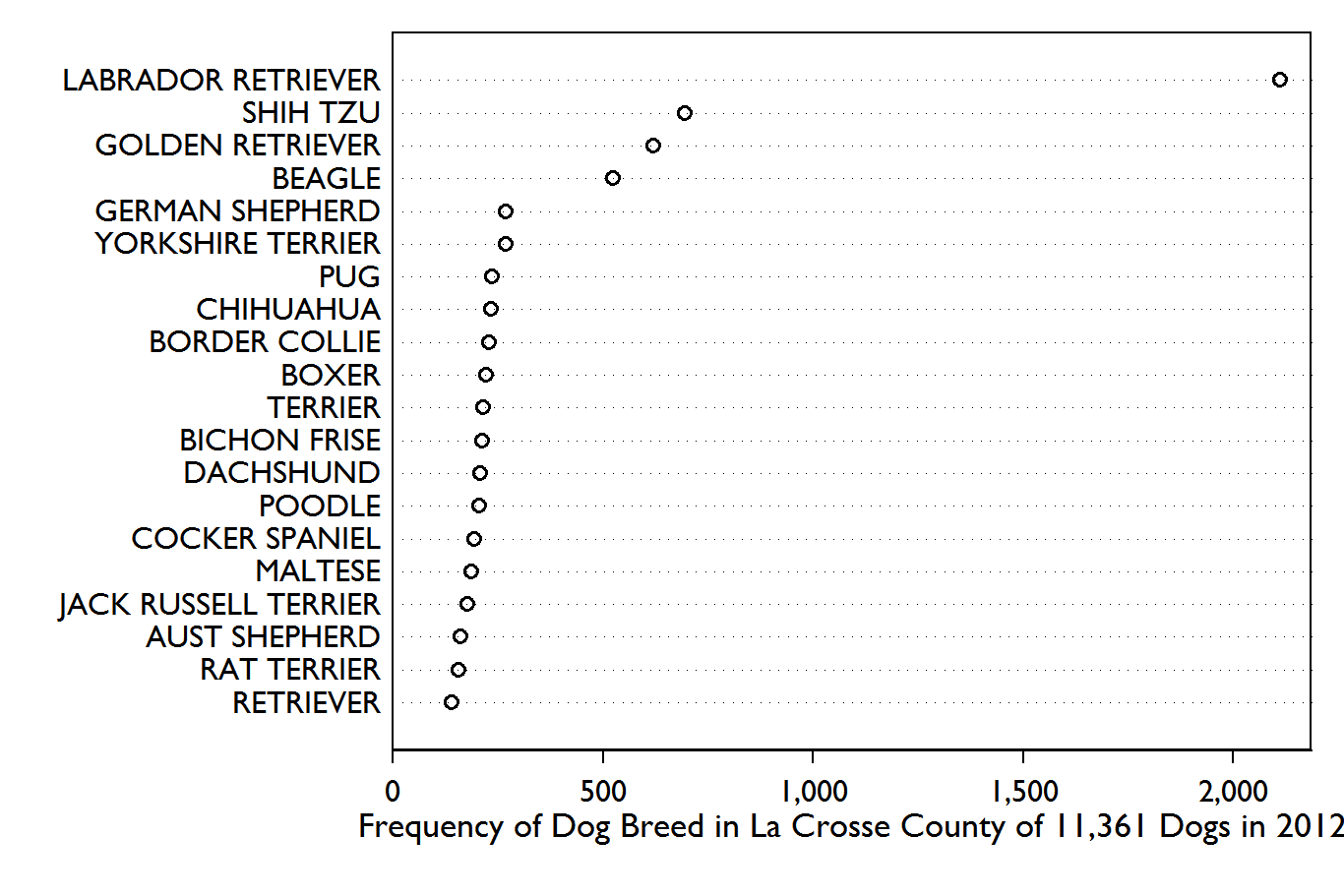
I love data. As an Economist and Professor you sometimes find yourself with interesting datasets that need to be shared. I have a group of students doing a project for a dog daycare in town. In order to survey dog owners we got the list of dog licenses from the county. It has the name, address of the owner, and the name, sex and breed of the dog. Below we have the top 20 names for dogs in La Crosse County for 2012. Remember these are licensed dogs.

Below I have the top 20 breeds from La Crosse.


Below I have the top 20 breeds from La Crosse.
Monday, January 23, 2012
What Not To Do
A great example of how not to design and deliver a presentation. In this commercial Microsoft demonstrates why they suck, or at the very least why their Ad Agency sucks.
Thursday, November 17, 2011
Profanity in Presentations
I use it too much in class, but almost not at all in public lectures. Here is an excellent discussion on the use in public speaking.
Thursday, September 29, 2011
Seminar: Jeff Williamson
The economics department will sponsor its first seminar speaker of the
2011-12 season on Friday, October 7th. Jeff Williamson, Laird Bell
Professor emeritus, Harvard University, and Professor of Economics,
University of Wisconsin - Madison, will be here to discuss his latest
book, "Trade and Poverty: When the Third World Fell Behind." We will
meet in room 122 Wimberly Hall at 3:30 pm.
Tuesday, September 27, 2011
Me Write Pretty One Day
Want to write better, or rather be a better writer? Just do it. A Lot. So says Seth.
Monday, September 26, 2011
Ethics?
We don't need no stinking code of ethics! We are ethical. Well, maybe we aren't any more or less ethical than anyone else, but you know that a priori, and a "code" of ethics merely leads to the moral hazard problem. Here is an excellent break down.
Tuesday, September 06, 2011
How to Study
Welcome to the Fall 2011 semester. Want to know how to do a better job of studying this semester? Check out this quick series of videos from a cognitive psychologist.
Thursday, September 01, 2011
Reasoning in Economics
Here is a discussion about behavioral econ, psych, and inductive versus deductive reasoning. It is wonderful throughout.
Monday, July 18, 2011
Brilliant
Conan O'Brien delivers an excellent graduation lecture at Dartmouth. The first 16 minutes are wonderful humor and fluff. At minute 16, he continues to be funny, but deeply introspective.
HT to Presentation Zen, who list three must see graduation presentations. And don't forget Conan's other tasteful piece. The "People of Earth" letter to NBC.
HT to Presentation Zen, who list three must see graduation presentations. And don't forget Conan's other tasteful piece. The "People of Earth" letter to NBC.
Subscribe to:
Posts (Atom)